Strategic Intelligence Feed
Real-time analysis of the resources and power shifts redefining global sovereignty
Finding Five and Burning Fifty
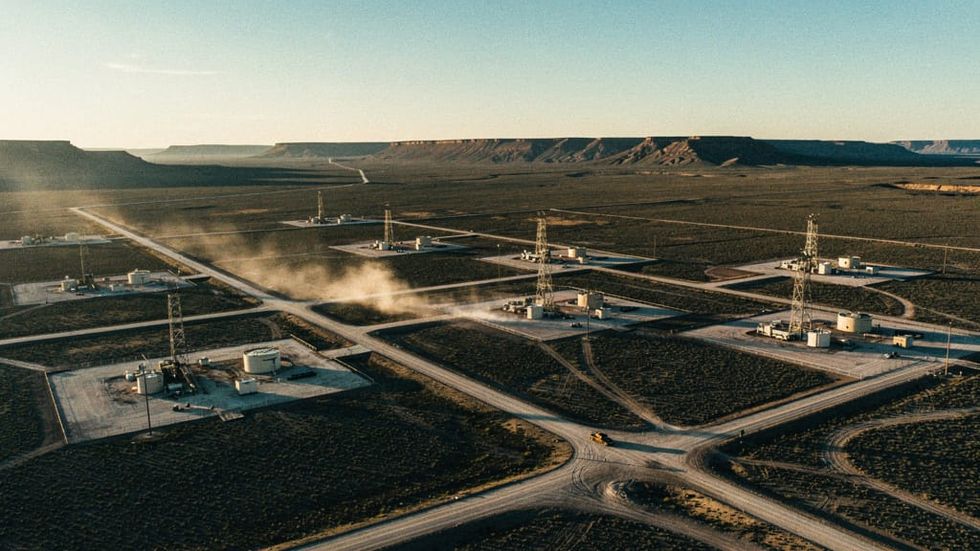
The world consumes something like thirty billion barrels of oil a year and roughly the same again in natural gas on an energy equivalent basis. Call it fifty four billion barrels of oil equivalent burned annually. Conventional discoveries have averaged about 5.5 billion barrels of
The world consumes something like thirty billion barrels of oil a year and roughly the same again in natural gas on an energy equivalent basis. Call it fifty four billion barrels of oil equivalent burned annually.
Conventional discoveries have averaged about 5.5 billion barrels of oil equivalent a year since 2023, according to Rystad Energy. In the early 2010s the figure was above twenty billion. The consultancy's own summary is that only twenty five to thirty percent of the oil consumed each year is currently being offset by new discoveries.
That gap has not produced a crisis, and the reason is also the reason it is likely to persist.
Exploration spending is running at about fifty to sixty billion dollars a year, down from a peak near 115 billion in 2013. That is not a response to failure but a deliberate reallocation. The industry decided after 2014 that it would rather return cash to shareholders and drill known rock than spend a decade proving up new basins, and its investors have rewarded the decision every year since.
The Historical Echo
The last time the industry decided it was cheaper to buy barrels than to find them, it reorganised itself in eighteen months.
Oil fell to about nine dollars a barrel in late 1998 and averaged 10.87 for the year, the lowest in more than a decade. What followed was the largest consolidation in the history of the business.
British Petroleum and Amoco announced their merger on the eleventh of August 1998, a 48.2 billion dollar all stock deal. Exxon and Mobil announced on the first of December 1998 at a headline value of about 75.4 billion dollars and a premium of 26.4 percent; the Federal Trade Commission cleared it at the end of November 1999 after requiring the largest asset divestiture ever imposed on a merger. Total and PetroFina announced on the same December day. BP Amoco agreed to buy ARCO in March 1999 for 26.6 billion dollars. TotalFina bid hostilely for Elf Aquitaine that July and completed the deal at 48.8 billion in September. Chevron announced its takeover of Texaco in October 2000.
The argument made at the time, and since confirmed in the academic literature, was explicit: it was cheaper to buy oil reserves on Wall Street than to find them with a drill bit.
Those deals were done at nine dollars a barrel, by managements in genuine distress, buying from other managements in genuine distress.
Where Patient Capital Is Positioning
The same logic is running again and the circumstances are inverted.
ExxonMobil bought Pioneer Natural Resources for sixty billion dollars, announced in October 2023. Chevron agreed to buy Hess for fifty three billion. Diamondback took Endeavor for twenty six billion and ConocoPhillips took Marathon Oil for 22.5 billion. This February Devon and Coterra announced a combination with an enterprise value around fifty eight billion dollars, completed in May.
None of that was done in distress. Oil has traded between roughly seventy and ninety six dollars through the period. These companies are not buying barrels because they are cheap. They are buying barrels because they are running out of the particular barrels they know how to drill profitably, and a competitor's acreage is the only place to get more.
The production statistics conceal how much of recent American growth is drilling geometry rather than geology. The average new horizontal well in the Permian basin had a lateral of 6,149 feet in 2015 and 10,867 feet last year, with wells longer than fifteen thousand feet going from almost none before 2020 to fifteen percent of completions. The number of new horizontal completions has been flat at roughly six thousand a year since 2022, and output rose 284 percent over the decade. Longer wells from the same count of holes, in the same rock.
Even the one major reporting clear reserve growth got it the 1999 way. Chevron ended last year with proved reserves about eight percent above the prior year, and the increase came from the Hess acquisition.
For capital that thinks across generations the observation is simple and uncomfortable. An industry can under invest in replacement for a very long time without consequence, because the inventory it already holds is enormous and the decline shows up slowly. What it cannot do is reverse the decision quickly. A conventional discovery takes the better part of a decade to produce a barrel, and the capability that finds one is people, seismic libraries and acreage positions that take just as long to rebuild as the fields themselves.
The Capital Memo