Strategic Intelligence Feed
Real-time analysis of the resources and power shifts redefining global sovereignty
The Paper River and the Real One
The rules that have governed the Colorado River since 2007 expire at the end of this year, and the replacement is now the subject of litigation. The Bureau of Reclamation published its final environmental impact statement on the thirty first of July, setting an operating framework
The rules that have governed the Colorado River since 2007 expire at the end of this year, and the replacement is now the subject of litigation. The Bureau of Reclamation published its final environmental impact statement on the thirty first of July, setting an operating framework for Lake Powell and Lake Mead from 2027 through 2036, with Lower Basin shortages of up to three million acre feet a year and releases from Powell ranging between five and twelve million acre feet depending on reservoir elevation. On the twenty fifth of August, Nevada and its water agencies sued the Department of the Interior seeking to void the framework entirely. Arizona has not filed but has declined to commit beyond the first two years.
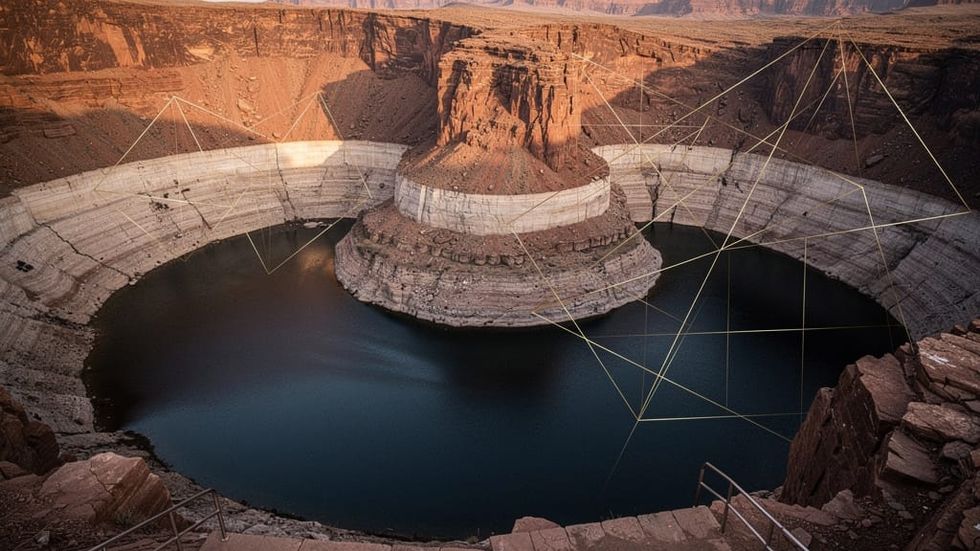
The physical situation behind the legal one is straightforward. As of early September, Lake Mead sits at about 26 percent of capacity and Lake Powell at about 22. Together the two largest reservoirs in the United States hold roughly a quarter of what they were built to hold. Agriculture accounts for somewhere around half of the river's consumptive use, and in the Upper Basin the great majority of irrigated water grows feed for cattle rather than food for people directly.
The Historical Echo
Everything now being argued over descends from a single document and a single number in it. The Colorado River Compact of 1922 divided the river between an Upper and a Lower Basin, allocating 7.5 million acre feet a year to each, with an additional million acre feet to the Lower Basin to account for Arizona's tributaries. The negotiators worked from an assumed average annual flow of about 18 million acre feet.
That figure was the problem, and it was nobody's dishonesty. The hydrological record available in 1922 covered a period later shown to have been unusually wet. The commissioners divided a river they believed existed, and the river that actually exists is smaller. A century of law, infrastructure, agriculture and city building has been constructed on top of entitlements that add to roughly sixteen million acre feet of paper water against a flow that has run persistently below it.
The consequence is a structure in which every party holds a legally valid claim and the claims collectively exceed the asset. That is not a novel situation in finance, where it is usually resolved by a default and a restructuring in which the most senior claims are paid and the rest are impaired. Water law resolves it the same way, through the doctrine of prior appropriation, under which the oldest right is served first and the newest goes dry first. The 1963 Supreme Court decision in Arizona v. California, which fixed the Lower Basin split at 4.4 million acre feet to California, 2.8 to Arizona and 300,000 to Nevada, was one such adjudication. Nevada's filing last month is the same mechanism starting again.
Where Patient Capital Is Positioning
The practical implication for anyone thinking about western land is that acreage and water have become genuinely separable assets, and the water is increasingly the more valuable of the two. Senior rights in the Colorado-Big Thompson system were trading around $52,000 per acre foot of annual yield in early 2024, up roughly 345 percent over the preceding decade. There are documented cases of farmland bought for its dirt and sold for its water at a multiple of the purchase price, with the ground left behind.
That repricing is what happens when a legal entitlement collides with a physical shortage. The paper claims are being sorted by seniority, and the market has begun pricing the seniority rather than the acres. A junior right on good soil is worth considerably less than a senior right on indifferent soil, which is a strange sentence to write about farming and an entirely ordinary one to write about claims on a scarce asset.
The broader principle is the one this letter keeps arriving at from different directions. When entitlements are created faster than the underlying resource, they do not all survive contact with it. What survives is the claim that stands first in line, and what determines that is usually a document signed long ago by people who could not have anticipated the circumstances in which it would finally be tested. For a family holding productive ground in the West, the question worth asking is not what the land yields this year. It is what the water right attached to it says, how old it is, and who stands ahead of it when the river comes up short.
The Capital Memo