Strategic Intelligence Feed
Real-time analysis of the resources and power shifts redefining global sovereignty
When Gold Stops Being Jewelry and Starts Being Savings
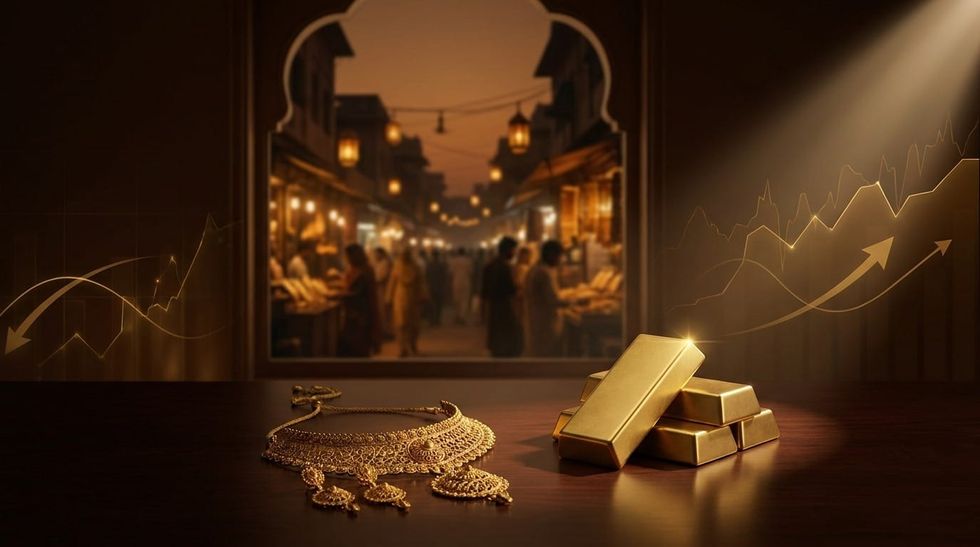
Gold demand in India and China, the world's two largest gold markets, is quietly changing shape. Jewelry purchases have softened as prices climb, but investment demand, bars and coins bought purely to hold value, has risen sharply, in India's case by more
Gold demand in India and China, the world's two largest gold markets, is quietly changing shape. Jewelry purchases have softened as prices climb, but investment demand, bars and coins bought purely to hold value, has risen sharply, in India's case by more than half in a single year. Together the two countries still account for over half of global jewelry demand and roughly half of global physical investment demand, but the mix between the two is shifting in a telling direction. The headline framing is a story about consumer spending patterns. The more revealing framing is that hundreds of millions of households are quietly reclassifying gold, moving it from the category of adornment into the category of savings, exactly at a moment when currencies and bank deposits feel less reliable than usual.
The Historical Echo
India's relationship with gold as a savings vehicle of last resort is not a recent development, and the country's own government provided the starkest demonstration of it in living memory. In the summer of 1991, India's foreign exchange reserves had collapsed to roughly 1.2 billion dollars, barely enough to cover three weeks of essential imports, leaving the government just weeks away from defaulting on its international payment obligations. With no other fast option available, the Reserve Bank of India airlifted 67 tons of the nation's gold reserves abroad, 20 tons to the Union Bank of Switzerland and 47 tons to the Bank of England, pledging the metal as collateral to raise emergency financing while a broader International Monetary Fund program was arranged.
The loans were structured as collateralized borrowing rather than an outright sale, and India repaid and recovered its gold within the year. But the episode revealed something important about gold's role even at the level of a sovereign government. When a nation's own currency reserves had been exhausted and its access to international credit was in doubt, gold was the one asset foreign lenders would accept without hesitation, precisely because its value did not depend on trusting the same government that was in the middle of a crisis. It functioned as collateral of last resort for the same reason it functions as a household's savings of last resort, its worth is independent of any single institution's promise.
Where Patient Capital Is Positioning
The shift now visible in Indian and Chinese gold buying, away from jewelry and toward bars and coins, is the household-level version of the same instinct the Reserve Bank of India acted on in 1991. Jewelry carries cultural and aesthetic value, but it is purchased and priced differently than gold bought explicitly to be held as a store of value, and the current data shows households increasingly making that second choice as prices climb rather than being deterred by them, a pattern that runs counter to how demand normally behaves when something gets more expensive.
For long-horizon capital anywhere in the world, the behavior of the largest gold buying populations on earth is a useful signal precisely because those populations have direct, multi-generational experience with currency instability that many Western households have not had to live through. When Indian and Chinese savers increasingly choose bars and coins over jewelry despite record prices, they are making a judgment about what actually holds value across a currency cycle, a judgment shaped by decades, and in some cases centuries, of watching paper money and even sovereign reserves come under pressure. That accumulated experience is worth paying attention to, whether or not it shows up in a headline about jewelry sales.
It is worth remembering, too, that the 1991 episode did not end with India abandoning gold as a reserve asset once the crisis passed. The country repaid its loans, recovered its bullion, and has since gone on to add substantially to its official gold holdings over the following decades, alongside the household demand described above. A brief moment of using gold as emergency collateral did not diminish the country's long-term relationship with the metal. If anything, it reinforced why that relationship exists in the first place.

The Capital Memo